
The best jobs aren't on job boards
The New York Times recently published an article on how applying to jobs feels like it’s ‘staring into the void’.
It wasn’t always this way. The frictionlessness of AI has broken the process.
Not long ago, it used to cost time and attention to apply to a job. A candidate had to navigate a job board to find a job, adapt their resume to the role, and write a cover letter to convey their fit to the hiring team.
This small friction was a blessing in disguise.
It required each job seeker to judge the likelihood of getting hired to be worth the modicum of effort invested. Employers benefited because it kept the application volume and quality reasonable. Job seekers benefited because the limited volume allowed employers to actually spend some time and effort to get to know applicants individually during the hiring process.
AI has rendered the application process frictionless and in doing so, doomed it.
What happened on both sides
Many free and paid tools now offer to navigate the entire process for job seekers and submit tailored applications to hundreds of roles in minutes.
The result is a deluge of applications for employers. Some of our customers report seeing thousands of applications within hours of posting a new role.
Vast numbers of new types of applicants, powered by other developments in AI like realtime deepfakes and coding agents, are joining the flood. Cheaters, liars, thieves, and state-sponsored operatives are expertly cashing in on their liar’s dividend and getting hired in record numbers. To the detriment of honest and qualified applicants.
It works in reverse too. In September, a fake recruiter contacted a Binance engineer on a job platform, interviewed him twice, then had him download a take-home assignment. It contained malware. The FBI tied the resulting $6.3 billion theft to North Korea.
Meanwhile recruiting teams haven’t grown. What’s the solution to AI flooding your applicant tracking system (ATS) with applicants? More AI, naturally. Nearly every ATS now includes integrated AI as table-stakes just to help navigate the application deluge. It’s not talked about much because the use of AI in ranking candidates is legally murky at best. No AI company wants to register as a recruiting agent and even OpenAI attempts to prevent its recruiters from attempting to use its AI to rank candidates. Many work around the safeguards anyway. Unfortunately there aren’t great alternatives.
By eliminating this small friction, AI has made the entire application process hell for both applicants and employers. It turns out hell can be frictionless.
Playing a different game
Meanwhile, some people seem blessed in the job market. They appear to have no trouble getting hired, often skipping from one desirable job to another. Experience, talent, and persistence still count. But there’s a bigger difference. They’re playing a different game. One that we would all be wise to start learning because in the near future this might be the only game where anyone wins.
The “secret” this group of people has figured out is, like most things, whenever there’s a front door, there’s usually a back door too. They know that the best jobs often don’t even have active postings. Several Icebreaker customers have raised tens of millions of dollars or more and are actively hiring for dozens of roles before even launching a website, let alone a public job board.
When the best opportunities aren’t even posted, how are job seekers supposed to find them? The same way they always have: through the power of their network. Every person has a network of people in their corner. Former colleagues, close friends, family, clubs and associations. While the internet made it unprecedentedly easy and fast to find and apply directly to opportunities, it displaced some of the slower, higher friction networking and relationship building we used to do.
Platforms would rather you consume their feeds than use your data. While LinkedIn is happy to replace your business cards, when you actually search for “engineers in my network” or “Neil’s contacts who are hiring in New York”, you can’t. Actual contact info on how to reach your network is not even downloadable, despite the same data being sold to anyone through their recruiting and sales products.
The smart networkers navigate around these intentional limitations by downloading their data and accessing it through their own tools like Icebreaker, Claude, or their private AIs. They create and maintain lists like “trusted connections”, “former colleagues I worked closely with”, “college friends” and set up monitors across all their social channels to stay updated and intentionally reconnect. This is one area where AI can actually help us improve our relationships with other humans.
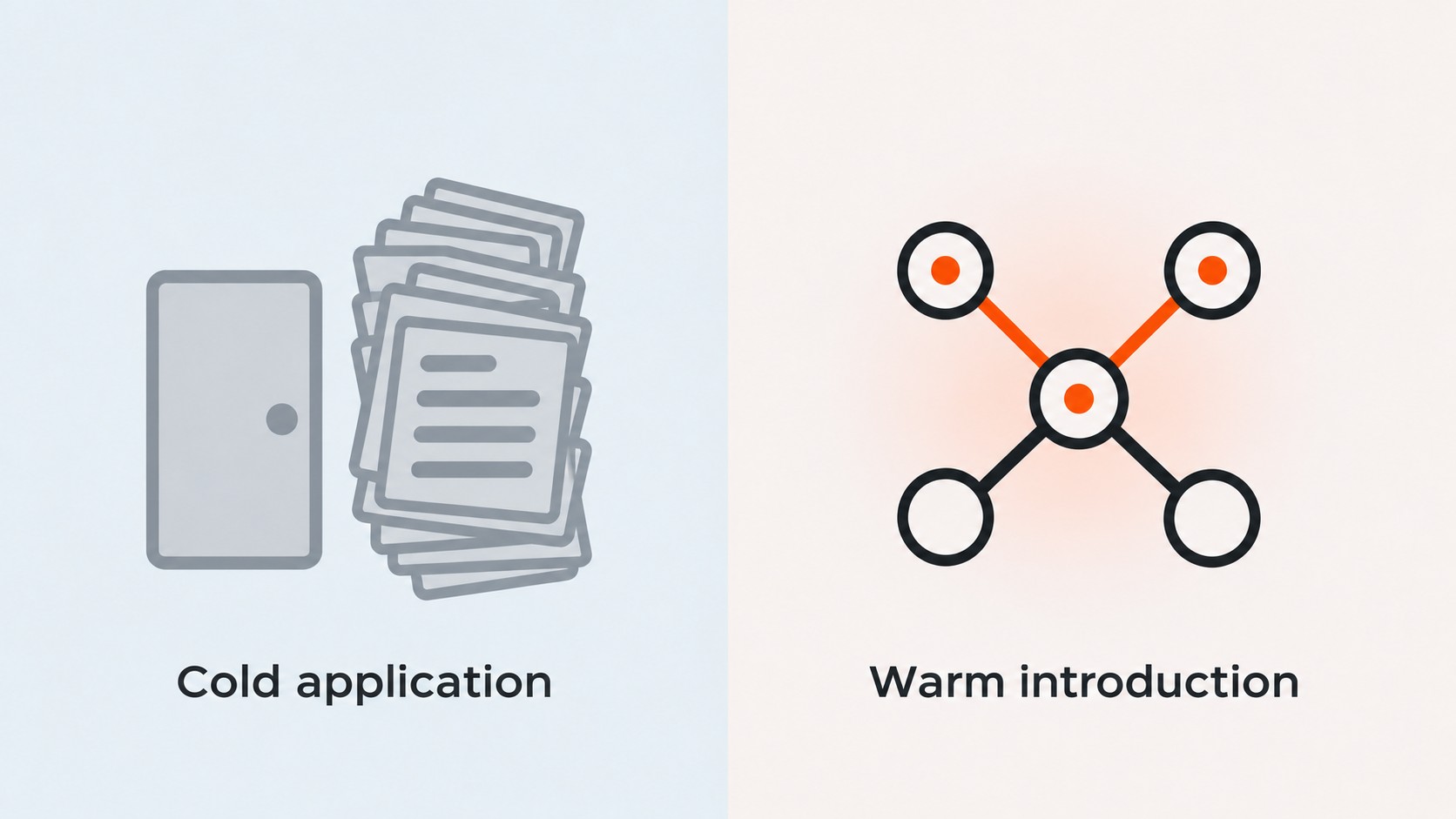
Between an application or a coffee, at least one always leaves you with a conversation.
And it’s durable. In an age when AI has begun to flood information, reviews, job boards, and everything else with fakes, it’s precisely the slower, higher friction cultivated relationships that will reemerge as our most trusted sources of information and opportunities.